
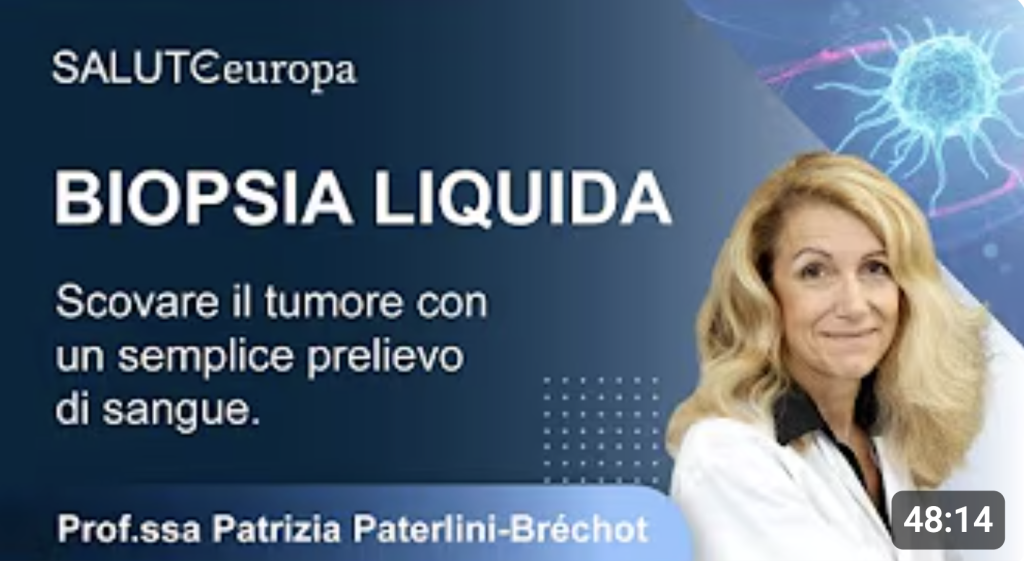

Hunting the “Invisible Enemy”: Liquid Biopsy and the Stage Zero Revolution
Detecting cancer years before it becomes visible through traditional diagnostic tests. This is the wager of Prof. Patrizia Paterlini-Bréchot and the technology that isolates “sentinels” in the bloodstream.
By Sergio Gentili (Translated from Italian: https://www.oncolife.it/news/biopsia-liquida/)
December 22, 2025
For decades, oncology has operated according to a consolidated paradigm: waiting for the “enemy” to reveal itself—whether as a symptom or a mass visible on a CT scan or MRI—before launching a counterattack with surgery, chemotherapy, or radiotherapy. But what if we could overturn this temporal logic? What if we could identify the disease while it is still a “ghost,” invisible to radiological instruments yet already present in our bodies?
This is the frontier of liquid biopsy, a field of research that promises to transform medicine from curative to preventive. Leading this revolution is an authoritative voice of Italian science on the global stage: Patrizia Paterlini-Bréchot, oncologist and hematologist, Professor of Cellular Biology at Paris Descartes University. She and her team developed the ISET technology, a method capable of isolating circulating tumor cells long before malignant tumors and metastases form.
Beyond DNA: Hunting the Whole Cell
When liquid biopsy is discussed, confusion often arises between two very different approaches. Most tests currently under development (such as those based on ctDNA) search for fragments of tumor DNA in the blood. These fragments usually originate from cells that die within an already-formed tumor mass.
Professor Paterlini’s approach is radically different: it does not look for debris (free DNA), but for the intact “soldier.” Her technology aims to isolate intact circulating tumor cells (CTCs).
The challenge is monumental: finding a single abnormal cell among billions of blood cells in a 10-ml blood sample. Using an ultra-sensitive filtration system based on cell size, healthy components are removed while rare tumor cells are retained without being destroyed.
The “Sentinels” and Stage Zero
In the earliest stages of tumor development—Stage Zero—some cells become pathological, detach from their tissue of origin, and enter the bloodstream. These cells often cannot yet form metastases, but their presence is an unequivocal warning signal.
Intervening at this stage means potentially stopping cancer before it becomes lethal.
The Dilemma of Early Diagnosis
If tumor cells are detected but imaging is still negative, clinicians face a therapeutic gap. The fear is causing anxiety without a clear intervention target.
Paterlini reframes this as risk management, similar to diabetes or cardiovascular disease. Early detection enables monitoring and lifestyle interventions that may restore immune function and eliminate early threats.
Future Challenges
The next frontier is identifying the tissue of origin. By integrating artificial intelligence and next-generation sequencing, tissue-specific DNA methylation patterns may guide targeted surveillance.
Toward a New Healthcare Model
The long-term goal is to make this testing routine and accessible. As blood tests once revolutionized leukemia detection, liquid biopsy may do the same for solid tumors—empowering patients and shifting medicine toward prevention.
Video interview with Rarecells founder, Dr. Patrizia Paterlini, MD, PhD: https://www.youtube.com/watch?v=wGRapqQDQwc&t=4s